Rows
Every row needs 1 to 9
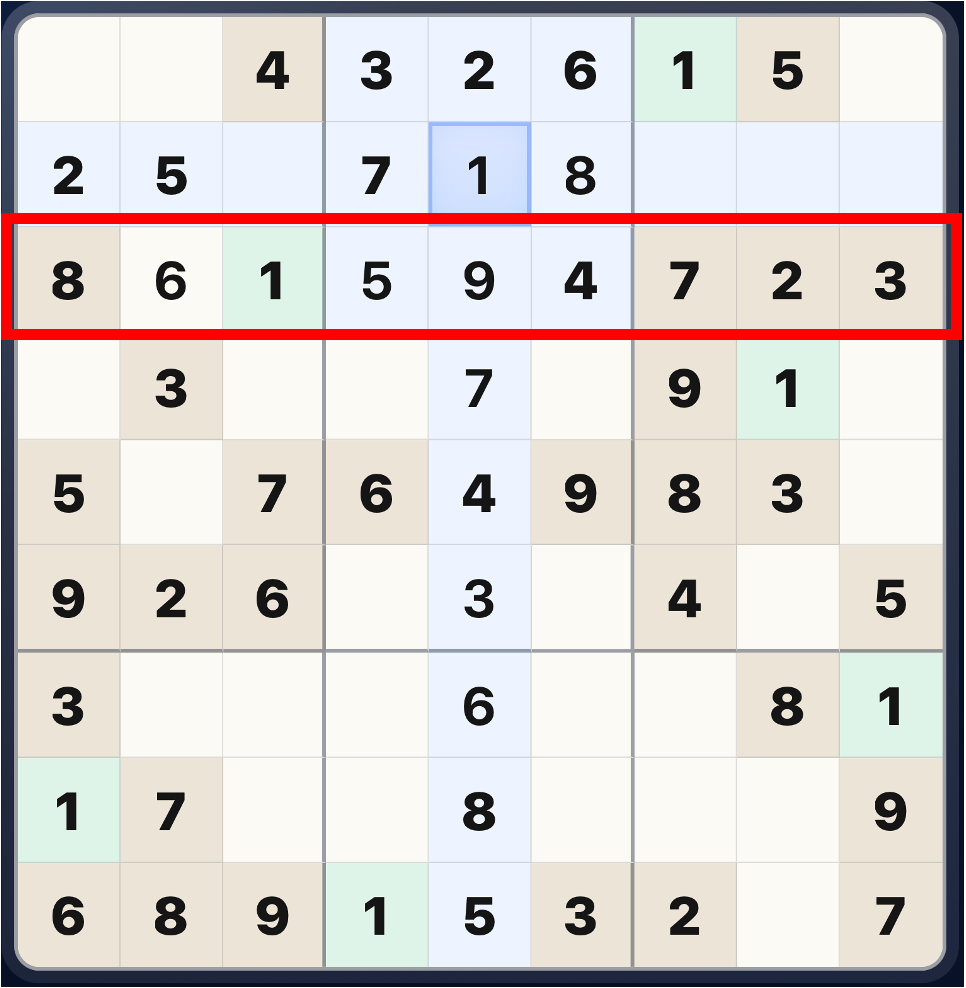
Each horizontal row must contain the digits 1 through 9 with no repeats.
Learn Sudoku by actually doing Sudoku. Watch a few simple moves, try some yourself, then move on to a real beginner puzzle.
Most Sudoku tutorials explain the rules and then leave you to figure everything out yourself.
This lesson is different. First you'll watch a few simple moves. Then you'll solve some yourself. Finally you'll be ready for your first real Sudoku puzzle.
No candidates. No advanced techniques. Just simple Sudoku logic.
First identify the missing number. Then click the correct cell.
Sudoku is a logic puzzle played on a 9x9 grid. The grid is divided into nine smaller 3x3 boxes. Your job is to fill every empty cell with a digit from 1 to 9.
The rule is simple: each row, each column and each 3x3 box must contain every digit from 1 to 9 exactly once. That means no repeated numbers in any row, column or box.
Sudoku looks numerical, but it is not a maths puzzle. You do not add, subtract or calculate totals. The numbers are really just symbols used for logical placement.
Each horizontal row must contain the digits 1 through 9 with no repeats.
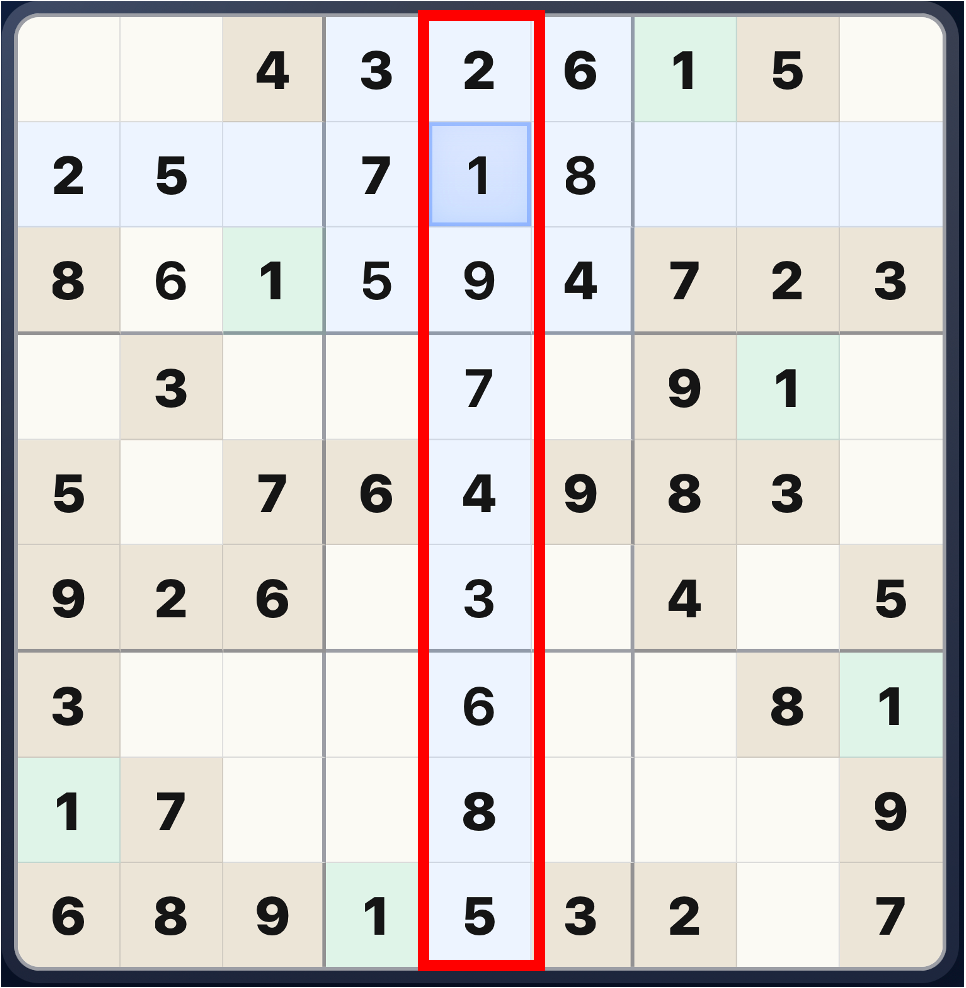
Each vertical column follows the same rule. If a digit already exists in that column, it cannot be placed there again.
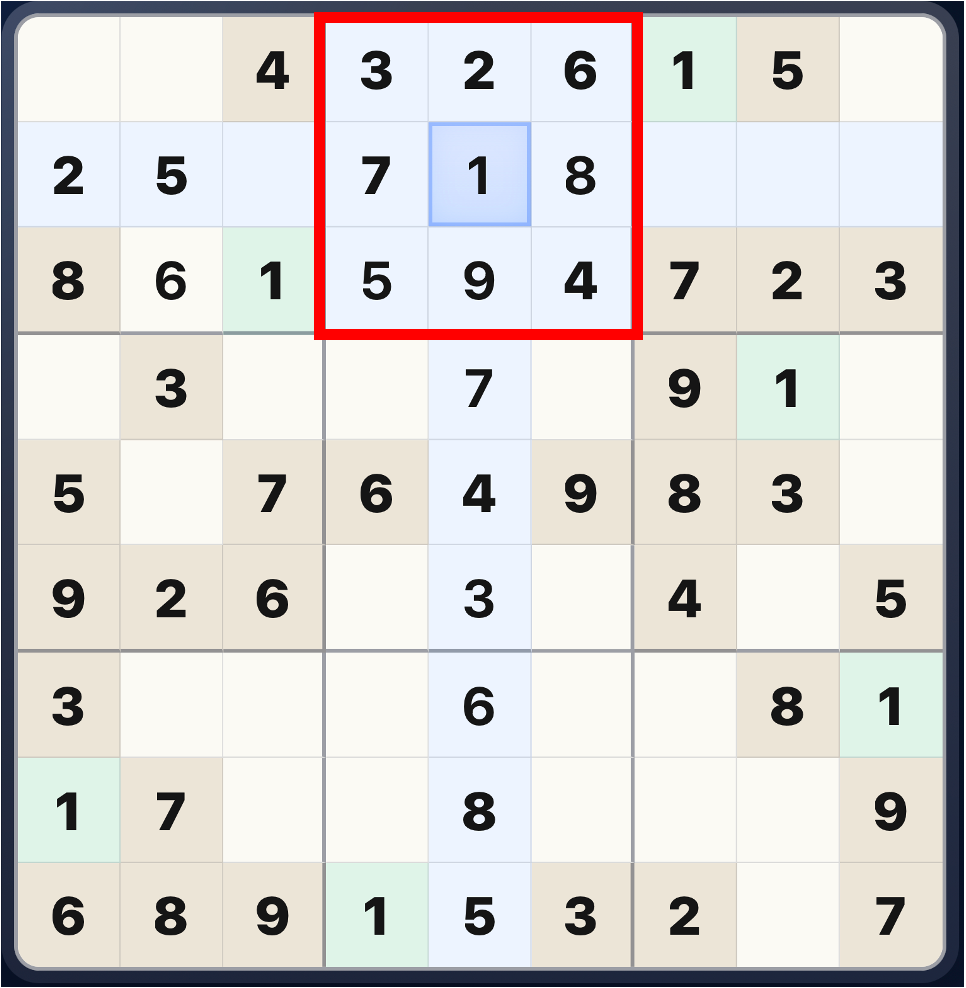
Each smaller 3x3 box also needs all digits from 1 to 9 exactly once. This is where Sudoku starts becoming satisfyingly awkward.
Start by looking for rows, columns or boxes that already contain many numbers. The more filled-in an area is, the fewer possibilities remain. This makes beginner Sudoku puzzles much easier to approach.
A good first technique is scanning. Pick a number, such as 5, and look across the grid to see where that number already appears. Use the row, column and box rules to eliminate places where the 5 cannot go.
When only one possible cell remains for a number, you have found a logical placement. Place the digit, then repeat the process. Sudoku is basically detective work, but with fewer trench coats.
Scan rows, columns and boxes to find digits that have only one legal position.
If a cell can only contain one possible digit, that digit must go there.
Use notes to record possible digits in harder cells instead of trying to hold the entire grid in your head like a caffeinated chess engine.
Notes, sometimes called pencil marks or candidates, are small possible numbers written inside an empty cell. They help you remember which digits could legally fit in that position.
For example, if a cell could be 2, 6 or 9, you can add those numbers as notes. Later, as more numbers are placed elsewhere in the grid, some of those candidates may become impossible and can be removed.
Notes are especially useful once you move beyond beginner Sudoku into medium, hard and master difficulty puzzles.
Good Sudoku should be solved logically. If you are guessing, slow down and look for another deduction.
Before placing a digit, check that it does not already appear in the same row, column or 3x3 box.
Speed comes after accuracy. Build clean solving habits first, then worry about leaderboard glory.
If you are new to Sudoku, start with beginner or easy puzzles. These levels usually contain more given numbers and rely on simpler logic, making them ideal for learning the rules and building confidence.
Medium Sudoku is a good next step once you are comfortable with scanning, singles and basic notes. Hard Sudoku and Master Sudoku require more advanced techniques and better candidate management.
Insane Sudoku should be approached only once you are emotionally prepared for a puzzle to stare back at you.
SudoSketch lets you practise Sudoku directly in your browser with clean controls, notes, highlighting, mistake checking and optional handwriting input.
You can play using keypad controls, touch, mouse, finger, stylus or Apple Pencil. Handwriting input is especially useful if you like the feel of paper Sudoku but want the convenience of a digital puzzle.
Start with beginner Sudoku, build up through easy and medium puzzles, then move towards hard, master and insane levels when you want a bigger challenge.
Start gently. The grid will still be there later when you fancy a proper scrap.
Fill the 9x9 grid so every row, every column and every 3x3 box contains the digits 1 to 9 exactly once.
No. Sudoku uses logic and elimination. The digits are symbols, not values you need to calculate.
Yes. Notes help beginners track possible digits and learn logical solving without guessing.
Start with Beginner or Easy Sudoku, then move to Medium once the basic logic feels comfortable.
Yes. SudoSketch lets you play Sudoku online for free with keypad, touch and optional handwriting input.